THE MEDICAL TREATMENT
OF
STONEWALL JACKSON
Nicholas Guenzel
AP United States History
December 13, 1995
Introduction
This paper will explore the events leading
to the
death of Thomas J. (Stonewall) Jackson in May of 1863.
Jackson had
become Robert E. Lee’s “right hand” in leading the Confederate
Army of Northern Virginia, which had been very successful to
that point in the Civil War. Because of Jackson's
prominence, his treatment was very well documented. This
paper will attempt to translate Jackson’s doctors’ writings into
modern-day medical terms, though this cannot always be done with
certainty. Then, when possible, a discussion of why the
doctors treated Jackson the way they did will follow.
This, again, is often a mystery. Finally, the treatment of
Jackson in 1863 will be compared to how such wounds might be
treated today. (Modern day medical thought on the treatment of
Jackson will be presented in parenthetical comments.) It
is ironic that Jackson was
shot three times, but he did not die directly from those gunshot
wounds. Instead, he contracted pneumonia under the careful
supervision of the best doctors the Confederate Army had to
offer.
The Infliction of
the Fatal
Wounds
Jackson, his commanders, and his troops
were together at Chancellorsville. Jackson’s corps had
just completed a daring and brilliant flanking maneuver that had
routed the Union Army. On Saturday, May
2, 1863, at around eight4
or nine7
in the evening, a party of about twenty men4
rode in front of a line of skirmishers scout the situation near
the Plank
Road (see Illustration 1). This group included
General Jackson,7
General A. P. Hill, some of Jackson's staff,4
and a few of his couriers. Upon returning in front of the
line formed
by the 18th North Carolina,7
this group, in the darkness, was mistaken for a body of Union
cavalry.5 Jackson
and the cluster of his men were fired upon by this regiment of
Jackson’s own corps. As a result of the shooting, several
men died and Jackson was wounded about fifty yards in front of
the enemy line.7
Jackson was struck by three balls during the incident. Two
of these projectiles landed in his left arm. The first,
and most serious wound, was about three inches below the
shoulder joint, “the ball dividing the main artery and
fracturing the bone.” (Farwell, 507.) (See
Illustration 2.)
The second injury in the left arm was several inches in
length. A
ball had entered the outside of the forearm, an inch below the
elbow.
The bullet came out on the opposite side, just above the
wrist. (See
Illustration 3.)
A third ball had entered the palm of the
right
hand. It landed in about the middle of his hand and
fractured two bones
as a result of passing through them. The bullet penetrated
and remained
in his hand.7 (See
Illustration 4.)
Field Treatment of
Jackson
Jackson was propped against a tree while
someone
was sent to fetch a doctor. It was discovered that there
were no ambulances within at least a mile. Wilbourn, an
officer who was present, then proceeded
to remove the general’s clothing, which was full of blood.4
Wilbourn placed a tourniquet on Jackson’s left arm2
and a sling was made for that same fast-swelling limb.
Some sources
claim Jackson drank a little brandy and a lot of water at this
time.4
Dr. Barr arrived and examined Jackson’s wounds. He came to the
conclusion that nothing could be done for Jackson until he
reached a field hospital.4
Dr. Barr deemed the tourniquet adequate and noted that Jackson's
blood had
started to clot.2
Jackson then took a few steps before a litter, otherwise known
as a stretcher, and two ambulance men arrived. The other
members of the group walked with their horses around him,
shielding him against4
the enemy projectiles of grape, canister, and shells of all
kinds.10
While on the litter, Jackson was carried through dense
undergrowth, which made the walking hard and slow. In all,
Jackson was carried about one-half of a mile on the litter.4
According to some sources, Jackson fell
from the
litter when one of the bearers was shot in both arms.7
However,
there is another account that grapeshot ripped both arms of an
ambulance
man and he started to drop his end of litter but another man
caught it before
Jackson fell; then, one of the bearers caught his foot in a
vine, stumbled,
and lost hold of the litter.
Regardless of the cause of the fall, all agree that Jackson fell
heavily to the ground on his right arm and shoulder. As a
result of this fall, Jackson groaned and almost fainted.4
After
he fell, Jackson was left lying alone for about five
minutes.
During this period, he lost a large amount of blood.4
After the fall and the brief delay, Jackson was put back on the
litter
and carried a few more yards until he met an ambulance.7
Arriving
with the ambulance was Dr. Hunter Holmes McGuire, Jackson’s
staff
surgeon. Dr. McGuire assessed Jackson’s injuries and
readjusted the
tourniquet on Jackson’s left arm. Jackson was in severe
shock.
His skin was clammy and cold, his face was chalk-white,10
his lips were compressed and bloodless, and his face was fixed
and rigid.7
He
had lost so much blood that he had become extremely weak.10
He
was given some whiskey and morphine.7
Jackson, at this point, was still four
miles from
the nearest field hospital4
at Wilderness
Run. The ambulance headed for the Corps Field Infirmary, at the
Wilderness
Tavern.7
(See
Illustration 1.) The ambulance had a plank floor and few
springs for
comfort. Joe Morrison, Jackson’s brother-in-law, held his
left arm
to lessen the shock during the ride. The road was so rough
that a rider
went ahead of the ambulance to warn of big bumps.2
Jackson was very calm and polite throughout the whole
ordeal. He
had complete control over his mind, even with the loss of blood
and tremendous pain he endured. He showed few signs of
suffering. The slight wrinkle of his brow and the
condition of his lips were the only outward expressions of his
pain. McGuire described this vividly: “. . . the
thin lips
so tightly compressed that the impression of the teeth could be
seen through
them” (McGuire 67.)
Jackson's clothes were covered with blood. The hemorrhages were
continuing from his wounds. McGuire compressed the artery
in Jackson’s left arm with his finger to stop the bleeding.7
Word had reached Dr. Black, who was in
charge of
the field hospital, that Jackson was on his way. Black had
a warm tent, blankets, whiskey, and water waiting. The
ambulance arrived at eleven-thirty. This was more than two
hours after Jackson had been wounded.4
(Today, a victim with Jackson’s wounds would be treated for
shock in the field and his condition stabilized before he was
ever moved. The treatment would consist of providing
intervenous fluids.6)
Jackson’s Field
Hospital Treatment
After Jackson arrived at the hospital, he
was put
in a bed and covered with blankets. He was also given more
whiskey and water.7
When Jackson first got to the field hospital, his pulse was weak
from loss of blood.2
McGuire made the decision to wait another two and a half hours
for Jackson to partially recover from the shock before further
treating his wounds.4
McGuire’s reasons for taking this plan of action are not known.6
(Such
a delay would not take place today.12)
After a long and torturous trip from the site of the injury to
the field hospital, and long delays for the shock to diminish,
Jackson went into surgery. Dr. McGuire, Dr. Black, Dr. R.
T Coleman, and Dr. Walls were all present during
the operation on Jackson. Dr. Coleman administered the
chloroform.4 He
folded a cloth in the shape of a cone and poured a large amount
of clear chloroform on it. Jackson was then told to exhale
fully and, as he then
drew the breath in, the doctor held the wet cloth a few inches
above Jackson’s
nose and mouth. This procedure was continued until Jackson
drifted off into
a state of unconsciousness.2
While
Jackson was receiving the chloroform, he said, “What an infinite
blessing,”
and continued to repeat those words until he lost
consciousness. (Farwell
512.) The chloroform was continually administered during
the operation
and Jackson was unconscious the entire time.7
First, a swift incision was used to remove
the
ball in Jackson’s right hand.10
The
ball came from a Springfield musket. This was a
Confederate ball,
not one of the Union’s, putting to rest any hope that Union
soldiers had
shot him.
Jackson’s other two wounds were treated by amputating his left
arm. The possibility of gangrene setting in was extremely
high.10
Jackson’s
left arm was amputated about two inches below the shoulder.7
The
operation was routine and one all of these doctors had performed
often
in the field. It was not considered to be dangerous.2
(Today,
according to Dr. Windle, Jackson’s arm most likely have been
saved,
provided there was adequate blood flow to the arm.12)
The amputation, performed by McGuire,4
was done very rapidly, with little loss of blood. The ordinary
circular operation
was used in this case.7
The
circular amputation was a very old technique, dating back to the
first century
A.D.4 The bone
was sawed off
with an appliance quite similar to a household saw.2
Dr.
Black, an internist, which is a specialist in internal medicine
(as opposed
to a surgeon), monitored Jackson’s heart during the operation.
Dr. Walls
tied the arteries at the conclusion of the procedure.4
Jackson also had two or three slight
wounds on
his face. These were a result of scraping his head
against the branches
of trees.7 His
face was dressed
with isinglass plaster. This is a gelatin obtained from
the air bladders
of various fish.4
After all of these procedures were complete, the dressings were
applied
and the anesthetic was terminated. It had been a
successful operation.2
The Post-Surgery
Period
Jackson regained consciousness at about
three-thirty on the morning of Sunday, May 3.9
He
drank coffee and did not sleep for quite a while. Later,
after McGuire
told Jackson that he needed rest, he fell asleep.2
At nine o'clock on Sunday morning, Jackson seemed almost free of
pain. He ate well and his mind was clear.4
All
the signs indicated he would recover.10
The
stump’s surface was covered with healthy granulations.
Lint and
water dressings were used for his stump and hand.8
At about ten o'clock in the morning,7
he complained of pain on the right side. He and the
doctors concluded
that this was a result of the fall he had taken from the litter.4
Jackson thought he had hit his right side against a stone or
stump of a sapling,
though McGuire found no signs of injury; the skin was not broken
or bruised
and his lung performed normally.7
McGuire recommended “some simple application” and hoped the pain
would disappear.4
On Sunday, Jackson was doing so well that the doctors though he
would be back in the field soon.2
By
eight o’clock on Sunday evening, the pain in Jackson’s side had
disappeared.7
Jackson
slept well Sunday night. (Vandiver, 491.)
On the morning of Monday, May 4, Jackson
was moved
by ambulance because Federal troops were threatening to cross
the nearby
Rapidan River at Ely’s Ford. (See Illustration 1.) Had
this event taken
place, it could have resulted in the capture of Jackson.
He was taken
twenty-four miles to Guiney’s Station, which is south of
Fredericksburg.4
The
road along the way was very rough. Soldiers were sent
ahead to
fill in some of the worst holes. The road was very crowded
with walkers,
other ambulances, and commissary, quartermaster, and ordinance
wagons.4
May 4, the day Jackson was moved, was very warm. Jackson
suffered
from slight nausea. The doctors placed a wet towel over his
stomach, which
relieved Jackson for the time being.7
In
the afternoon, he again felt slight nausea. A damp cloth
provided
relief from the nausea, but the pain in his side returned.
At eight o'clock in the evening, during a thunderstorm, the
ambulance arrived at the Chandler house at Guiney’s
station. There were other officers in the house and
McGuire thought it would not be healthy for Jackson to be placed
there. For one thing, it was not quiet enough for
Jackson. There was also a case of erysipelas in the house.4
Lastly,
McGuire thought there was a danger of infection because some
soldiers
had died in the make-shift hospital.3
Near the main house, there was a small building where Jackson
was placed
to keep him away from these harmful things. After Jackson
arrived at
Chandler’s house, he ate bread, drank tea, and slept for a long
time.4
Jackson was very refreshed the next
morning, which
was Tuesday, May 5. He ate a lot, his wounds were healing,
and there
were no signs of infection in his stump. Though he showed
good signs,
his hand gave him a little pain.4
A
light, short splint was put on the palm of his hand,7
“to assist in keeping at rest the fragments of the second and
third metacarpal
bones.” (McGuire, 520.) (See Illustration 4.) Lime and
water dressings
were also used for his stump and hand. Jackson was very
satisfied when
he was told his wounds were healing well. He asked how
long he would
be kept from the field. On Wednesday, May 6, Jackson was
also thought
to be doing very well. He ate a lot of food and was
cheerful.7
At
one o’clock on Thursday morning, May 7, Jackson had nausea and
towels
were again applied. The remedy did not work this
time. McGuire
then listened to Jackson’s chest and found pneumonia in the
right lung.3
The
pneumonia flushed Jackson’s cheeks and oppressed his breathing.11
The
nausea may have been a result of the inflammation from the
pneumonia,
instead of the fall.7
McGuire came to the conclusion that the
wet clothes had not caused the pneumonia, but they did not help
it, either.10
The disease came too soon after the application of the wet
clothes to have
been induced by them, as was once believed.7
McGuire
thought the lung inflammation might have started when Jackson
was
dropped from the litter.10
(However,
modern medical knowledge suggests that the fall probably did not
start lung inflammation, unless he broke some ribs. Had
some ribs been
broken, the pain might have kept him from taking sufficiently
deep breaths,
contributing to his pneumonia; but no such pain was noted.
Otherwise,
falling off the litter may have contributed to the inflammation,
but Jackson’s
inactivity was most likely the cause of his pneumonia. If
he was not
turned and moved frequently, fluid would have gravitated to his
lungs, creating
a rich medium for bacteria. If some bacteria found its way
into the
lung, it would have grown fast and possibly caused the
pneumonia.6
Jackson thought that he might have gotten pneumonia on May 1,
the night
before he was shot. During that night, he slept without
any cover on
pine-needles.9
(Doctors today doubt that the fact that Jackson slept without
covering probably had anything to with his catching
pneumonia. However, if he had been out in cold a lot, his
resistance to infection would have been lowered. This
would have caused him to become more prone to this illness, but
not a
direct cause of it.6)
After the onset of pneumonia, Jackson was
drugged
with morphia to decrease the pain. He was delirious at
times, while
rational at others. (Vandiver, 492.) He talked
gibberish much
of the time. Sometimes he acted as if he was in other
situations.3
(It
is known now that Jackson’s delirium probably resulted
from the
lack antibiotics. The infection probably spread from the
lungs into
the bloodstream. This probably caused him to act in this
manner.6)
The
pneumonia was now benumbing his senses. He suffered
greatly on
Friday and Saturday, May 8 and 9.10
The doctors examined Jackson and came to the conclusion that his
ailment was pleuro-pneumonia of the right side.7
(Though
there is no word for pleuro-pneumonia of the right side in
modern
medical terms, there is a lining around the lung called the
“pleura.”
It is a double layer, similar to a bag around the lung.
This lining
is often inflamed when pneumonia is contrived. A sound can
be heard
when this lining is involved, which is most
likely what McGuire heard. McGuire probably meant that
Jackson had pneumonia involving the pleura when he said that
Jackson had pleuro-pneumonia.6)
McGuire explained Jackson’s illness as “contusion of the lung,
with extravation of blood in his chest, was probably produced by
the fall . . .” (McGuire 70.) Extravation is where
blood comes out of the body, specifically the chest in this
case. (This is, most likely, not what happened.
Contusion of the lung could have resulted from the fall of
Jackson, but without breaking a rib, such bleeding would have
been unlikely.6)
McGuire
also explained that “ . . . shock and loss of blood, prevented
any
ill effects until reaction had been well established, and then
inflammation
ensued.” (McGuire 70.)
The standard treatment for this ailment
was cupping. In this process, hot glasses were applied to
the afflicted area to draw blood, a process requiring
opium. Mercury and antimony, two metals, were also used in
this cure.4
This
process was used to out the poison.6
Jackson’s wounds were dressed again on Friday, May 8.7
The
quantity of discharge from the wounds diminished8
and the healing process was still taking place. The pain
in his side
disappeared, but he had difficulty breathing and felt exhausted.7
Anna,
Jackson’s wife, thought his fever and restlessness caused him to
grow
weaker.
When Dr. Morrison, who was experienced in dealing with
pneumonia, saw Jackson he said, “There is an old familiar face,”
referring to the pneumonia. (Farwell 522.) On this
day, Dr. Morrison told Jackson that he might not recover.4
Jackson had a fever developing, so his
face was
given a cold sponging to help his condition.2
Dr.
David Tucker from Richmond, who was also knowledgeable in the
care of
pneumonia, came on Saturday. Everything possible was done
to save Jackson.
He suffered no pain and his breathing was less difficult, but he
grew weaker
each hour.7
(Jackson’s
ease in breathing may have been because he tired suddenly.
Before this, his breathing was mosst likely fast, due to the
infection.
Then, he probably could not breath as quickly because of
fatigue, so his
breathing slowed. If this was the case, he would have
appeared to be
doing better, when, in fact, his condition was deteriorating.6)
Sunday, the tenth of May, 1863, was a warm and pleasant
day. The
doctors told Anna they had done all they could and Jackson was
going to die
in a few hours. Anna then told this news to her husband.4
At one-thirty on Sunday afternoon, Jackson was told he had two
hours to
live. The doctors were very close in guessing the time of
death of
Jackson. “Nineteenth-century doctors watched so many of
their patients
die that they became adept at predicting the hour of death.”4
Near the end, Jackson’s mind began to
fail even
more frequently than before. Jackson sank into
unconsciousness, murmuring disconnected words from time to
time.4
At three-fifteen7
(or three-thirty, depending upon which source is consulted), he
said cheerfully,
“Let us cross over the river and rest under the shade of the
trees.”
(Farwell 526.) His features then sank into repose and he
died,4
eight days after he had been shot at Chancellorsville.5
It is generally accepted that Jackson did not of his gun-shot
wounds or
his surgery. The symptoms, as described by Dr. McGuire,
are not completely translatable into modern terms. McGuire’s
daily records were lost after they were captured by Union troops
in 1865. Most authorities agree that Jackson
died of pneumonia. This was not uncommon, as pneumonia was
fatal for
one in six Confederate soldiers who contracted the disease.4
(Jackson probably did not have pneumonia before he was
show. It is common
for people who suffer trauma to develop pneumonia. This is
at least
partly because they are put in bed, kept still, and do not take
sufficiently deep breaths.6)
It is believed by some that Jackson might,
in addition, have suffered some intraabdominal injury when his
litter was dropped.4
(An intraabdominal injury is one that is below the diaphragm,4
that is usually internal, such as the rupture of an organ with
resulting
internal bleeding.1
According
to Dr. Plummer, it is unlikely, but possible, that Jackson had
an intraabdominal
injury.6)
Conclusion
The doctors did all that they could for
Jackson
with the technology of the day. They had very basic
practices and knowledge, compared to their present day
counterparts. They did not have blood transfusion
abilities or a good understanding of infection.4
These
are helpful, if not necessary, for successful treatment of
complicated
medical problems.
The death of Jackson is a very complicated
subject
that is not easy to understand. There are many
contradictory reports
in different sources. While Dr. McGuire probably kept very
revealing
notes, those notes were lost in 1865. Perhaps due to that,
modern authorities cannot agree on the exact cause of Jackson’s
death. However, all agree that the death of Jackson was
very significant in the outcome of the Civil War. Had
Jackson been in command throughout the war, many claim the
Confederates would have won. For example, just a few weeks
later, the crucial Battle of Gettysburg took place, and many
argue that Jackson, who would have commanded the field for
the confederates on the first day, would have pressed the
initial Confederate advantage to a full victory, perhaps
changing the outcome of the war.
WORKS CITED
1
Abele,
Carol (Cardiac re-hab nurse, Gothenburg, Nebraska).
Telephone
interview. 7 Dec. 1995.
2
Bowers,
John. Stonewall Jackson: Portrait of a
Soldier.
New York: William Morrow and Company, Inc., 1989
3
Davis,
Burke. They Called Him Stonewall. New York:
Holt, Rinehart and Winston, 1954.
4
Farwell,
Byron. Stonewall: A Biography of General Thomas
J. Jackson. New York: W. W. Norton & Company,
1992.
5
McPherson,
James M. Battle Cry of Freedom. New York:
Ballantine Books, 1988.
6
Plummer,
Dr. Al (Emory University Hospital, Atlanta, Georgia).
Telephone interview. 6 Dec. 1995.
7
Schildt,
John W. Hunter Holmes McGuire: Doctor in Gray.
Chewsville: John W. Schildt, 1986.
8
Selby,
John. Stonewall Jackson as a Military Commander.
London: B.T. Datsford Ltd D. Van Ostrand Company, Inc.,
1968.
9
Tate,
Allen. Stonewall Jackson. U of Michigan: Ann
Arbor Paperbacks, 1957.
10
Vandiver,
Frank E. Mighty Stonewall. U of Texas:
Texas A & M University Press, 1957.
11
Wheeler,
Richard. We Knew Stonewall Jackson. New York:
Thomas Y. Crowell Company, 1977.
12
Windle, Dr.
Rick (general surgeon, Lincoln, Nebraska). Telephone
interview.
30 Nov. 1995.
Special thanks to Dr. James Wengert, Member of the Board of
Trustees of
the Nebraska State Historica Society and a military medicine
history authority, for his suggestion of this topic, his help with
key sources used, and his general guidance.
Chronology
Event
Time and Day
1. Rode in front of lines, shot
8-9:00 P.M.,
Sat., May 2
2. Medical care at hospital
11:30,
P.M., Sat.,
May 3
3. Removal of bullet and amputation
2:00 A.M., Sun., May 3
4. Morning
9-10:00
A.M., Sun.,
May 3
5. Night
8:00 P.M., Sun., May 3
6. Start moving to another hospital
Morning, Mon., May 4
7. Afternoon and arrival
8:00
P.M., Mon., May 4
8. Wounds healing
Morning, Tue., May 5
9. Nausea, pneumonia diagnosed
May 6-7
10. Healing, exhausted, hard breathing
Fri, May 8
11. All possible done, growing weaker
Sat, May 9
12. Dying
Sun, May 10
13. Told was going to die, died
1:30-3:30 Sun, May 10
Illustrations
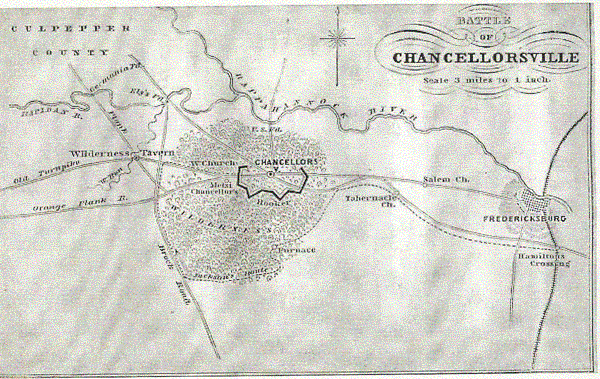 Figure 1
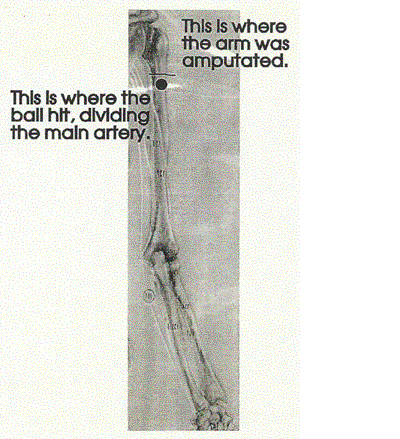 Figure 2
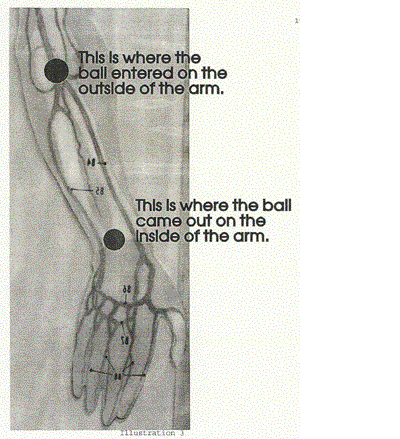 Figure 3
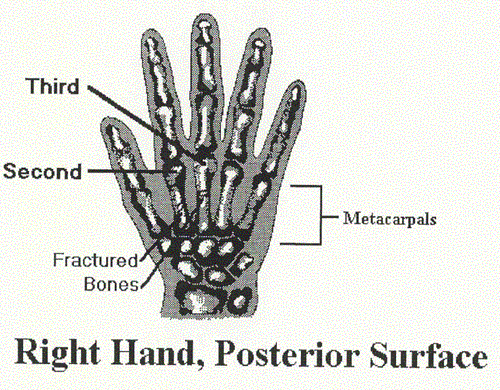 Figure 4